Somewhere in Africa, about 150,000 to 200,000 years ago, a woman lived whose genetic legacy connects every person alive today. She wasn’t the first woman, nor the only one of her time, but her mitochondrial DNA has been passed down unbroken through generations of mothers.
We know her today as Mitochondrial Eve. Not a biblical figure, but a scientific anchor point in our shared human story.
The Science of Mitochondrial DNA
To understand Mitochondrial Eve, we must first comprehend mitochondrial DNA (mtDNA).
Mitochondria are often called the powerhouses of the cell, but they also contain their own DNA. This DNA tells a story that goes far beyond energy production. Unlike the DNA in your cell nucleus (which comes from both parents), mitochondrial DNA is inherited solely from your mother. That’s because when sperm fertilizes an egg, the mitochondria in the sperm are destroyed, leaving only the mother’s mtDNA to be passed on. This unbroken chain creates a direct genetic timeline, connecting every person to their maternal ancestors stretching back thousands of years.
It also mutates a lot between generations. These subtle genetic shifts create a timeline that scientists can read like an ancient manuscript, tracing maternal lineages from mother to child, generation after generation.
Each person’s mtDNA can be compared with others to determine how closely they’re related or which haplogroup, a branch of the maternal family tree, they belong to. These haplogroups map out ancient human migrations and reveal the origin of your maternal line on Earth.
A bit more science, for the geeky ones 🤓
While I can write a ton about DNA recombination, I would just state that DNA recombination is a process where sections of DNA from your parents’ chromosomes mix and swap places. This shuffling creates new combinations of genes, forming new chromosomes. These new chromosomes are derived from both of your parents, but aren’t identical to either one of them. This makes you, you.
 The white one is a chromosome from one parent, the black one is from another. After crossover, the new chromosome has parts of both.
The mitochondrial DNA, however, doesn’t have any male counterpart to mix and swap. Hence, there’s zero recombination in mtDNA. This property makes it easier to track changes across generations. Mitochondrial DNA only changes due to mutations, that too occur only in certain regions.
Combined, these two characteristics of mtDNA make it the perfect tool to study ancestry. The high rate of mutation makes it easier to distinguish between generations, and no recombination allows us to track the constant, non-changing parts easily.
(Apart from mtDNA, the Y-chromosome also shows rare recombination, because there’s no female counterpart of Y-Chromosome. This founds the stepping stone of tracking male ancestry. But that’s a topic for some other day.)
A simple analogy
Imagine every woman on the earth has a soup recipe. Each soup tastes different. And when the soup is passed to the next generation, the mothers add some more ingredients.
Now, if your and mine soup share 100 ingredients, but differ in 5 ingredients, that means we probably had the same great-great-great-great-grandmother (Assuming each generation's mother added/changed one ingredient).
A Genetic Map of Migration
By comparing mtDNA from people around the world, researchers can group lineages into haplogroups, branches on the maternal family tree. Each haplogroup represents a cluster of people who share a common maternal ancestor and often a distinct migration path.
Using this genetic map, scientists have reconstructed how humanity spread across the globe:
- Our shared maternal ancestor, Mitochondrial Eve, lived in Africa.
- Over tens of thousands of years, her descendants migrated out of Africa, branching into new haplogroups as they adapted to different regions: Europe, Asia, Oceania, and eventually the Americas.
- These genetic signatures still exist today, woven into the DNA of people across every continent.
So when you take a genetic ancestry test and it traces your maternal haplogroup to, say, “H” or “L3,” you’re looking at the path your ancient mothers took. Step by step, generation by generation, from prehistoric Africa to where your family lives today.
 A map showing all the haplogroups. L is the root (not shown explicitly in the map), from which L0-6 originate. L3 further branches into M and N. As it can be seen, most of the L level groups are present in Africa, hinting that Mitochondrial Eve was most likely in Africa.
Why her?
Now, Mitochondrial Eve was neither the first woman nor the only woman alive during that period. So naturally, a question arises. Why is the current Mitochondrial Eve the “Mitochondrial Eve”? Why not someone else?
The answer to this is pretty straightforward, and probably too easy to guess. As we stated above, mtDNA is only inherited from the mother. So, it is possible that somewhere in the bloodlines of other women alive at that time, a woman had only male offspring, or no offspring at all. Hence, their mtDNA didn’t pass along.
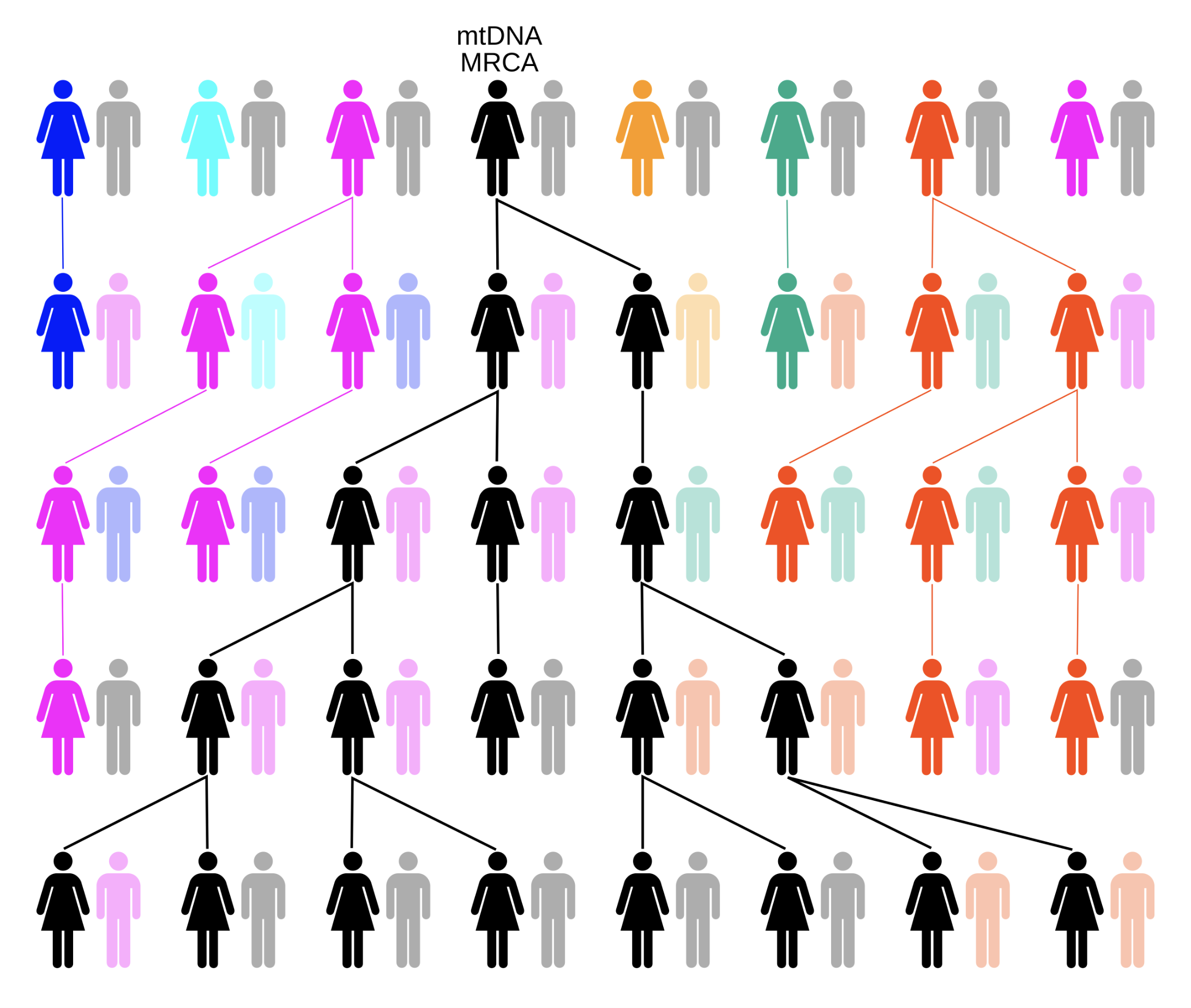
The above chart depicts the passing of mtDNA in generations of women. Apart from black line, all other women either had only male offspring, or no offspring at all.
What Mitochondrial Eve Tells Us About Evolution
Mitochondrial Eve doesn’t represent the “first” human, but rather the most recent common maternal ancestor whose mtDNA survived in all living humans. Her existence gives scientists a genetic clock to measure the rate of human evolution. By comparing mtDNA mutations among global populations, researchers can estimate when different human groups diverged and how they evolved.
This has provided some of the strongest evidence for the “Out of Africa” theory, the idea that all modern humans originated in Africa and later dispersed worldwide, replacing older hominin species. Mitochondrial Eve, therefore, anchors the story of our shared humanity in both genetics and geography.
From One Woman to All of Us
The story of Mitochondrial Eve reminds us that every human alive today, no matter their race, culture, or continent, shares a maternal link to a single woman who lived long ago. Her legacy endures not in monuments or records, but in the very cells of our bodies.
In each heartbeat, in every strand of hair, her DNA continues to whisper a story of migration, adaptation, and survival, a story that stretches across millennia and binds all of humanity to one ancient mother.
References
- The Two People We're All Related To
- Mitochondrial DNA and human evolution
- Mitochondrial Eve - Wikipedia
- 106- Mitochondrial Eve and Y-Chromosomal Adam | Podyssey
All images are taken from Wikipedia, except the cover image.