When Silence and Light Turn Into Illusion
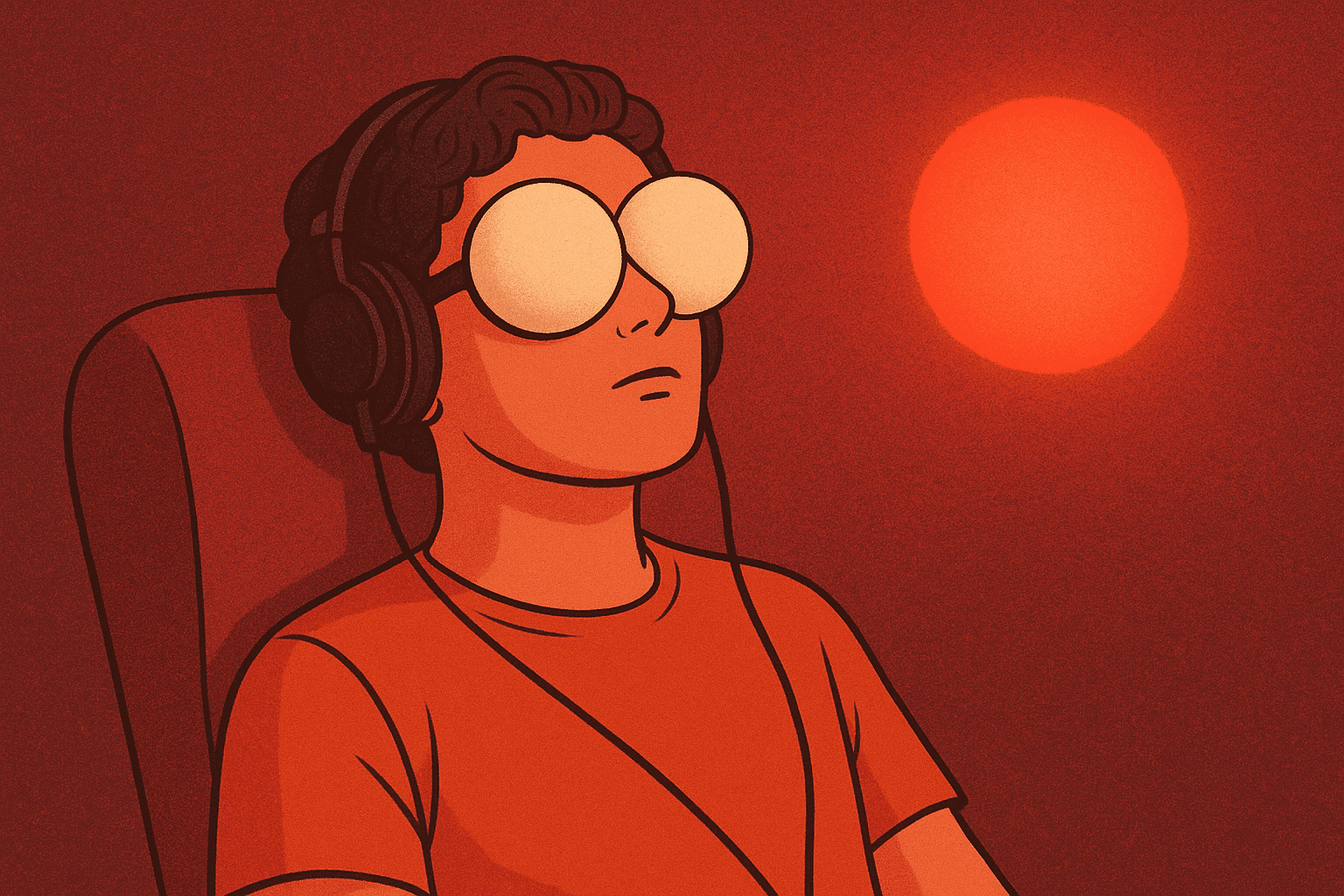
Imagine this: your eyes are covered with halved ping-pong balls, red light washes over your face, and the air vibrates with steady white noise. Minutes pass. Shapes flicker. Colors swirl. You start to hear faint voices - or perhaps, your own mind speaking back to you.
That’s the Ganzfeld Effect, a psychological state born from sensory deprivation. By removing variation in light, sound, and touch, the brain is forced to invent its own stimulation - creating a surreal blend of hallucination and self-generated experience.
Neuroscientists call this “perceptual homogenization”. When sensory input becomes too constant, your brain amplifies its internal noise, turning imagination into vivid sensory reality.
The Ganzfeld as a Gateway to Telepathy
In the 1970s, this same setup: ping-pong balls, red light, white noise, became the centerpiece of one of psychology’s boldest claims: proof of telepathy.
The Ganzfeld protocol paired two people in different rooms. One, the sender, focused on an image or film clip. The other, the receiver, sat in the sensory isolation of the Ganzfeld environment, describing whatever came to mind.
Afterward, the receiver chose which image they thought the sender had been viewing. Early studies appeared to show above-chance accuracy, and for a time, it seemed that telepathic communication might finally have experimental support.
Parapsychologists hailed the Ganzfeld as scientific validation of ESP, while skeptics questioned whether the findings were too good to be true.
Sensory Deprivation, Hallucinations, and the Brain
Not all interest in the Ganzfeld effect centers on the paranormal. Modern psychologists and neuroscientists use it to study perception under sensory deprivation — exploring why hallucinations occur in the absence of external stimuli.
Even without any paranormal context, people frequently report vivid imagery, emotional reactions, and altered states of awareness. These experiences share similarities with those induced by floatation tanks, meditation, and hypnagogic states, suggesting that the Ganzfeld effect reveals the brain’s intrinsic tendency to find patterns and meaning in noise.
Essentially, when sensory input stops, the mind becomes its own projector.
Science Strikes Back: Chris French and the Replication Reckoning
Skeptical psychologists, notably Chris French, examined these studies and identified serious replication failures and statistical inconsistencies. French’s critiques focused on:
- Small sample sizes and publication bias (positive results more likely to be published).
- Loose scoring criteria, especially in “free-response” designs.
- The difficulty of maintaining proper blinding between experimenters and participants.
Other researchers pointed out the difference between free-response and forced-choice designs. In the free-response method, participants describe their impressions freely, which can later be interpreted in many ways, opening the door to confirmation bias. The forced-choice approach, in contrast, limits participants to specific options, providing clearer statistical outcomes but often eliminating the illusion of telepathic hits.
These criticisms helped shift the consensus: rather than proof of ESP, Ganzfeld telepathy experiments demonstrated how human expectation, suggestibility, and chance can mimic paranormal effects under carefully structured conditions.
From Parapsychology to Neuroscience
While the Ganzfeld’s role in ESP research has largely faded, it remains a powerful experimental and artistic tool. Far from debunking the phenomenon itself, these studies revealed something even more fascinating: the mind’s creative power under sensory deprivation.
Contemporary artists like James Turrell use Ganzfeld installations to explore the boundaries of light and perception. Some cognitive scientists use Ganzfeld-like sensory deprivation setups to study how the brain’s intrinsic activity—especially within the default mode network—gives rise to internally generated experiences when external input is minimized.
Once a tool for testing telepathy, the Ganzfeld has become a window into the nature of consciousness itself.
Key Takeaways
- The Ganzfeld Effect induces vivid hallucinations through sensory deprivation.
- Parapsychologists once used it to claim evidence for telepathy (ESP), but later replication failures exposed flaws in the research.
- Chris French’s critiques reshaped the debate, showing that expectation and chance - not psychic ability - drove the results.
- Today, the Ganzfeld remains a powerful tool for studying perception, creativity, and consciousness.